
Blog
What I Change in My Home Before the Holiday Season Begins
By Kate Longley • Kate Longley Designs
People sometimes assume that designers do something dramatic to their homes for the holidays.
A complete transformation. New everything. The kind of reveal you see in a magazine spread where the house looks entirely different from one month to the next.
What I do is much quieter than that. And I find that the quieter changes are almost always the ones that feel the most right.
The first thing I tend to change in my own home in Scottsdale is the tables.
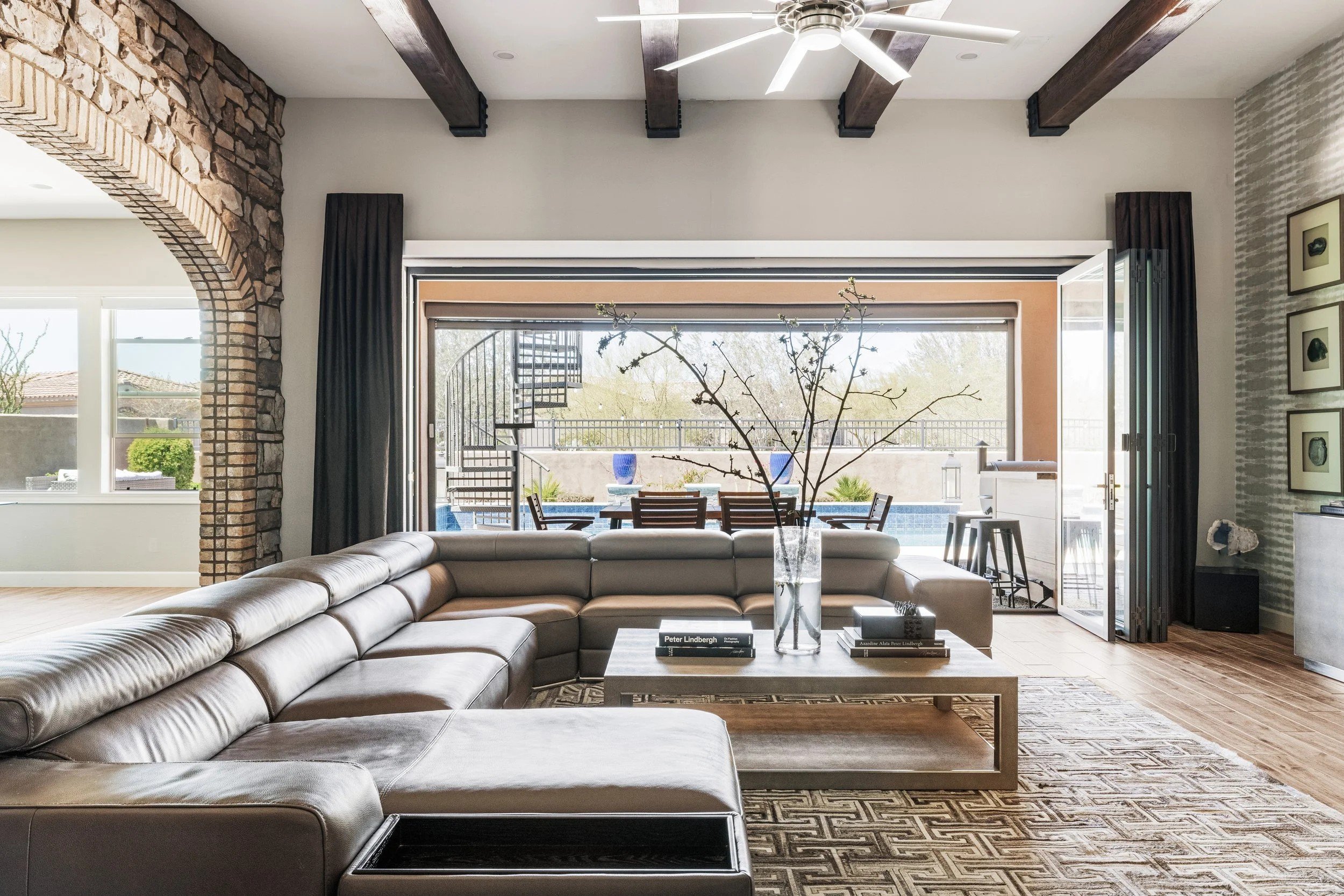
Not the dining table necessarily. I mean the surfaces in the rooms where people gather. The coffee table. The console. The little table by the front door. I’ll clear them almost completely and reset them with just a few things that feel right for the season. A bowl of something from outside. A stack of books I want to read over the holidays. An object I love that usually lives somewhere else in the house.
It’s a small shift, but it changes the feeling of a room more than I’d expect every time I do it. Those surfaces set the tone. When they feel considered, the whole room tends to follow.
The second thing I love doing is bringing the outside in.
Arizona has such beautiful things growing in October and November that it feels almost wasteful not to use them. Dried grass. Branches with interesting structure. A single succulent stem in a vessel on its own. Nothing elaborate. Just a few things from outside placed simply somewhere inside.
There’s something about natural material in a home during the holidays that feels grounding rather than decorative. It connects the house to where it is, which in the desert this time of year is a genuinely lovely place to be.
The third thing is scent, which I think people underestimate.
A home that smells right for the season feels festive before you’ve even registered why. A real candle in something warm and woody. Fresh greenery if you’re using it anywhere. Something simmering in the kitchen if people are coming over. It’s one of those things that guests rarely comment on directly but always seem to feel. The house just has a different quality when you walk in.
The last thing I do is rotate a few pieces of art.
Things that feel a little warmer and more intimate than what’s up the rest of the year. A small drawing. A photograph that means something. It makes the rooms feel more personal somehow, more like somewhere someone lives and loves, which is exactly the feeling you want when the house is full of people.
None of what I’ve described costs very much or takes very long. It’s mostly just a little attention paid in the right direction before the season arrives rather than after.
And I find that’s really all a home needs to feel ready.
If you’re thinking about a bigger project going into the new year, I’d love to be part of that conversation. I work with a small number of clients at a time, and I’m thoughtful about fit.
KATE LONGLEY DESIGNS
Paradise Valley · Scottsdale, Arizona
The Lighting Decisions That Make a Luxury Home Feel Festive Without Looking Overdone
By Kate Longley • Kate Longley Designs
The holidays have a way of making people do things to their homes they would never do in January.
Lights everywhere. Candles on every surface. And sometimes it all works beautifully. But sometimes you walk into a room that’s trying so hard to feel festive that it just feels busy. The warmth you were going for gets a little lost in all the effort.
I’ve been thinking about why that happens. And I think it comes down to one thing. Festive lighting isn’t about adding more light. It’s about being a little more intentional with the light you already have.
The first thing I’d try is to warm everything down.
If you haven’t already switched to warm bulbs, the holidays are a lovely moment to do it. Warm light makes candlelight look better, makes food look better, makes people look better. It’s one of the simplest changes you can make, and the difference is immediate.
And if you have dimmers, now is the time to use them. There’s something about a room at sixty percent brightness that just feels different. More settled. More like somewhere you want to stay.
Candles are my favorite tool this time of year, but I think they work best when they’re placed with a little thought rather than everywhere at once.
The dining table. The coffee table. A console in the entry that’s the first thing guests see when they walk in. A few in the right spots do more for the feeling of a room than a lot of them scattered without a plan. I also love varying the height and grouping them rather than spacing them out evenly. It feels more collected that way, less like a display.
The thing that surprises people most when I talk about holiday lighting is this: letting some corners stay a little dark.
It sounds counterintuitive. But a room with some shadow and depth feels so much more atmospheric than one that’s uniformly bright. The darkness is what makes the candlelight glow. It’s what gives the room that sense of occasion that’s hard to put your finger on but very easy to feel.
In Paradise Valley especially, where the evenings are mild and you can have the doors open, the way warm light spills from inside into the night is one of my favorite things about the holidays here.
The goal, I think, is a home that feels like something special is happening without announcing it too loudly.
Warm. A little golden. You don’t need very much to get there. Just the right things, in the right places, turned down just enough.
If you’re thinking about a larger lighting project or a renovation going into the new year, I’d love to talk through it. I work with a small number of clients at a time, and I’m thoughtful about fit.
KATE LONGLEY DESIGNS
Paradise Valley · Scottsdale, Arizona
How to Prepare Your Home for a Photoshoot
By Kate Longley • Kate Longley Designs
There is a specific kind of panic that sets in the morning of a photoshoot.
You’ve spent months, sometimes years, on a project. The design is done. Everything is in place. And then the photographer arrives and suddenly you’re seeing every surface with fresh eyes, and nothing looks quite the way you thought it did.
I’ve been through enough of these to know that the panic is almost always avoidable.
The most important thing you can do before a photoshoot has nothing to do with styling or flowers or last-minute shopping.
It’s editing.
Walk through every room and take out anything that doesn’t need to be there. The charger on the kitchen counter. The stack of mail on the entry table. The candle that’s burned down too far to look intentional. These things disappear from our everyday vision because we stop seeing them. A camera sees all of them.
The goal isn’t a home that looks unlived in. It’s a home where everything visible is there on purpose.
Once you’ve edited, then you style. And styling is just making the things that are already there look their best. Fluff the pillows and push them slightly askew so they don’t look like a hotel. Put a single stem in a vessel you already own rather than buying an elaborate arrangement that looks like it belongs somewhere else.
The homes that photograph most beautifully are seldom the ones where someone went out and bought a lot of new things. They’re the ones where someone paid close attention to what was already there.
Light is everything. Turn off overhead lighting and let the natural light do the work. Overhead lights flatten the room in photographs. Lamps are better. And if you can, shoot in the morning when the light is softer. South-facing rooms in Arizona can be tricky in the afternoon, so knowing which rooms you’re shooting at what time of day matters more than most people expect.
The last thing I’d say is to give yourself more time than you think you need. Editing and styling always take longer than they look like they will. Build that in.
The shoot itself is the easy part. Everything before it is where real work happens. And when the images come back, and the home looks exactly the way you always hoped it would, that work will have been completely worth it.
If you’re thinking about a bigger project and want it ready for the holidays or the new year, I’d love to talk. I work with a small number of clients at a time, and I’m thoughtful about fit.
KATE LONGLEY DESIGNS
Paradise Valley · Scottsdale, Arizona
How to Design Your Home for the Holidays Before October Is Over
By Kate Longley • Kate Longley Designs
Here’s something I’ve noticed after years of working on homes in Arizona.
The holidays arrive differently here. There’s no frost on the windows, no leaves turning outside here in Scottsdale. The shift from October to November to December is subtle, and it can catch you off guard. Then suddenly it’s the week before Thanksgiving, and the house doesn’t feel ready, and you’re not quite sure how to get there.
I’ve learned to get ahead of that feeling. And the secret, if there is one, is simpler than most people think.
Start before you’re in the mood.
I know that sounds counterintuitive. Most of us want to wait until we feel the holiday spirit before we start doing anything about it. But the homes that feel genuinely beautiful and ready during the holidays are rarely the ones that got pulled together at the last minute. They’re the ones where someone made a few thoughtful decisions in October, while there was still time to be intentional about it.
That’s the window we’re in right now. And it goes faster than it feels like it will.
The first thing I’d think about is light.
The days do get shorter here in November and December, earlier than most people expect. And when the sun goes down in Arizona in the winter, the evenings have a quality that’s worth designing around. Candles matter more than people realize this time of year. A few well-placed ones in the rooms you gather in most will do more for the feeling of your home than almost any decoration you could buy. Warm bulbs if you haven’t switched already. Dimmers if you have them. The goal is a home that feels like it’s glowing from the inside, and in Arizona’s mild evenings that’s something you can enjoy with the doors open and the desert air coming in.
The second thing is texture.
The holidays are the one time of year when it feels completely natural to layer. An extra throw on the sofa. A few more pillows in something rich and tactile. A table runner that makes the dining table feel set even when it isn’t. None of this requires a major investment or a complete overhaul. It’s just adding a little more warmth and weight to the rooms where people are going to gather.
In a desert home especially, that layering can feel genuinely transformative. We tend to live lighter the rest of the year. The holidays are permission to lean in a little.
The third thing, and honestly the most important, is editing before you add.
Before you bring anything new into the house, take a few things out. Clear the surfaces that have gotten cluttered over the year. Give the rooms a little room to breathe. Holiday decorating almost always looks better against a calmer backdrop, and the homes that feel most special during this time of year are rarely the most decorated ones. They’re the ones where everything that’s there feels chosen.
That editing step is the one most people skip, and it makes all the difference.
The holidays in Arizona have their own particular magic. The warm evenings. The way candlelight looks against adobe or plaster. The fact that you can be outside with your guests in December in a way that most of the country can’t. Designing for that, rather than trying to recreate a cozy northern winter that doesn’t quite fit the climate, is what makes a desert home feel genuinely festive rather than just decorated.
You have time to do this well. But October is the moment to start.
If you’re thinking about a bigger project and want it ready for the holidays or the new year, I’d love to talk. I work with a small number of clients at a time, and I’m thoughtful about fit.
KATE LONGLEY DESIGNS
Paradise Valley · Scottsdale, Arizona
What the Runway Is Already Telling Us About 2027 Interiors in Scottsdale
By Kate Longley • Kate Longley Designs
Every few years I notice something shift on the runway and think: that’s going to end up in someone’s living room.
It sounds like a strange connection. Clothes and interiors feel like completely different worlds. But they’re not, really. They’re both a response to the same thing: how people want to feel. And fashion just happens to get there first.
What shows up in Paris or Milan in the spring tends to show up in shelter magazines eighteen months later and in new construction two years after that. I’ve watched it happen enough times that I now pay close attention to the runway specifically because of what it tells me about where homes are heading.
The connection makes more sense than it might seem.
Fashion and interiors are both responding to the same cultural moment. The same collective mood. When people are craving warmth and texture and depth, you see it in clothing first. Fabrics get richer. Silhouettes get softer. And then, not long after, you start to see it in the homes people want to live in.
The runway isn’t leading anyone anywhere. It’s just the first place the feeling shows up.
So what is the feeling right now?
Across the major collections this season, one word keeps appearing. Restraint. Not minimalism, which can feel cold and empty. Restraint, which feels intentional and calm. The palettes are deep and grounded. Earthy greens, warm charcoals, rich browns, camel. Materials that reward a closer look. Textures that feel as good as they look. Craft that takes time to fully appreciate.
There is very little shouting happening on the runway right now. And that tells me something.
For Arizona specifically, I find this moment really interesting.
We’ve been in a long run of warm whites and sandy neutrals, which have been beautiful and right for this light. But the signal from fashion is that the palette is ready to deepen. To get more grounded and specific. The rooms I expect to be working on in 2027 will have more weight to them. More intention in their color story. Not dark exactly. Just more settled.
The texture shift translates here too. A plaster wall instead of a painted one. A honed stone surface instead of polished. A wire-brushed floor instead of something glassy and reflective. These are the kinds of choices that will feel completely at home in a Scottsdale house two years from now, in the kind of light we live with every day.
The cultural mood is shifting in a direction, and that direction is worth understanding before you make decisions that will live in your home for the next decade. The clients who are thinking about this now, at the planning stage, are the ones who end up with homes that feel considered and current without having chased anything.
That’s always the goal. And right now, the runway is giving us a very clear picture of where considered is headed.
If you’re in the early stages of a project and want to talk through what this means for your home specifically, I’d love that conversation. I work with a small number of clients at a time, and I’m thoughtful about fit.
KATE LONGLEY DESIGNS
Paradise Valley · Scottsdale, Arizona
From Runways to Residences: How I Translate Fashion Trends into Interior Decisions Two Years Ahead
By Kate Longley • Kate Longley Designs
People are sometimes surprised when they find out I follow fashion.
Not because I'm particularly interested in what to wear. But because fashion has always been the earliest signal for where interiors are heading. What shows up on a runway in Milan or Paris in October tends to appear in shelter magazines 18 months later and in new construction 2 years after that.
Once you see that pattern, you can't unsee it.
The connection makes more sense than it might at first.
Fashion and interiors are responding to the same cultural moment. The same collective mood. When people crave warmth and softness, you see it in clothing first. Textures get richer. Silhouettes get easier. Colors pull toward the earthy and the natural. And then, not long after, you start to see it in the homes people want to live in.
The runway isn't dictating anything. It's just the first place the feeling shows up.
So, what am I actually looking for when I'm paying attention to fashion?
Not the specific pieces. I'm looking at the mood underneath everything. Is there a material showing up across multiple designers that nobody was using two years ago? Is the overall feeling getting quieter or louder? More intimate or more dramatic? Those shifts tell me something real about where people's heads are, and where their homes are going next.
It's a little like reading the weather. You're not watching one cloud. You're watching the whole sky.
Here's what that means in practice.
When I'm sitting with a client making finish decisions, I'm not thinking about what's in showrooms right now. I'm thinking about what the cultural conversation has been telling me for the past year or two, and whether the choices we're making will feel right when the home is finished and lived in. Because that gap between decision and completion is where a lot of regret is born.
Getting ahead of it isn't about being clever. It's just about paying attention to the right things early enough to make decisions without the pressure of the moment.
The clients I love working with most are the ones who are curious about this. Who want to understand not just what to choose but why, and why now. Because when you understand the why, the decisions get so much easier.
And the result is a home that feels current without trying to be. Which, honestly, is the best possible outcome.
If that's the kind of thinking you want behind your project, I'd love to talk. I work with a small number of clients at a time, and I'm thoughtful about fit.
KATE LONGLEY DESIGNS
Paradise Valley · Scottsdale, Arizona
Why Designing for Right Now Is the Most Expensive Mistake a Luxury Homeowner Can Make
BY KATE LONGLEY • KATE LONGLEY DESIGNS
Can I share something I wish more people knew before they started designing their home?
The choices that feel the most exciting in the moment are sometimes the ones that are hardest to live with later. Not because they were wrong exactly. Just because they belonged to a moment that eventually passed.
And in a home you've invested everything in, that's a feeling worth trying to avoid.
Here's what I mean.
Every few years there's a moment where a certain look is everywhere. A particular tile. A finish. A color palette that shows up in every new build and every shelter magazine at the same time. And it's beautiful. It genuinely is. That's the whole problem.
Because beautiful and timeless are not the same thing. And the difference between them is something you usually only discover a few years too late.
I've seen it happen more times than I can count. A homeowner falls in love with what's having a moment, builds an entire home around it, and then watches that moment pass. The home starts to feel dated before it ever really felt finished. And undoing it is never as simple as swapping out a pillow.
The good news is that avoiding this isn't about playing it safe. It's almost the opposite.
The homes that age beautifully are the ones built around something real. A genuine love of a material. A connection to a place. A piece that has personal meaning. Those things don't go out of style because they were never really in style to begin with. They belong to the person who lives there, and that kind of belonging doesn't have an expiration date.
What goes out of style is the version of your home that was designed for anyone. The version that could have belonged to a thousand different people. The one where every choice made sense on paper but none of it was really, deeply yours.
I think about this every time a client comes to me with a mood board full of images they love. My first question is never "do these work together." It's "how long have you loved these things?"
If the answer is "I just started seeing them everywhere, and they feel so right," that's useful information. It means we might be chasing the moment rather than the meaning.
If the answer is "I've been drawn to this for years, and I can't explain why," that's where we start. That's the thing worth building around.
Trends are fun. I'm not immune to them, and I'm not asking you to be either. But there's a difference between letting a trend inform a decision and letting it make the decision for you.
Your home should still feel like yours in ten years. It should still feel right when the thing that's everywhere right now is nowhere to be seen. That's the standard worth designing from.
And it's a much better investment than chasing what's beautiful today.
If you're in the early stages of a project and want to think through what lasting really looks like for your home, I'd love that conversation. I work with a small number of clients at a time, and I'm thoughtful about fit. The project application is where we start.
KATE LONGLEY DESIGNS
Paradise Valley · Scottsdale, Arizona
How I Source Art for a Private Residence So It Feels Collected, Not Decorated
BY KATE LONGLEY • KATE LONGLEY DESIGNS
Let me tell you the difference between a home that feels collected and one that feels decorated.
In a decorated home, the art matches the sofa. In a collected home, you have no idea how the art and the sofa ended up in the same room together, and somehow, it's perfect.
That second feeling is what we're after. And getting there is more fun than most people think.
The first thing I tell clients is this: we are not shopping for art. We are looking for things you can't stop thinking about.
There's a big difference. Shopping for art is how you end up with something that fills the wall and fills absolutely nothing else. Looking for things you can't stop thinking about is how you end up with a home that has a story.
So, before we buy a single thing, I want to know what you already love. The postcard you've had on your fridge for six years. The print you bought at a market in another city and never got around to framing. The artist whose work you keep coming back to online. That's the beginning of a collection, whether you knew it or not.
One of the things I love most about putting a collection together is the mix.
A significant piece next to something modest. A work on paper next to an oil. Something old next to something made last year. There's something about contrast that makes everything feel more alive. The pieces are in conversation with each other rather than just sharing a wall.
When it's all working, you don't notice any of that. You just feel it.
The question I get asked most often is some version of: how do I know if something is good?
My honest answer is that good is the wrong question. The right question is: does this make me feel something? Because art that makes you feel something every time you walk past it is art that is doing its job. It doesn't need a gallery behind it or a price tag that makes you nervous. It just needs to be something you genuinely love.
That's what a collection is. Not a portfolio. Not a statement. Just a room full of things that mean something to the person who lives there.
And honestly, building that together with a client is one of my favorite parts of this whole job.
If you're starting from scratch or adding to what you already have, I'd love to be part of the search. I work with a small number of clients at a time, and I'm thoughtful about fit
KATE LONGLEY DESIGNS
Paradise Valley · Scottsdale, Arizona
Why One Considered Decision Always Outperforms Ten Safe Ones
BY KATE LONGLEY • KATE LONGLEY DESIGNS
I want to talk about playing it safe.
Because I understand the impulse: you're making decisions that will live in your home for years, maybe decades. So, you pull back a little. You choose the neutral. You go with the thing that will definitely work rather than the thing you love.
And then the room is fine. Perfectly fine. And fine is the most deflating word in the English language when you're talking about your home.
Here's what I've noticed after years of doing this work.
The rooms people fall in love with are rarely the result of ten careful, sensible decisions. They're the result of one real one. One moment when someone said yes to the thing that made them a little nervous. The wallpaper they almost didn't order. The sofa in the color everyone told them was too bold. The light fixture that felt like too much until it was installed and then felt exactly right.
That one decision changes everything around it. It gives the room a pulse.
Safe choices aren't bad choices. But when every single decision in a room is a safe one, something gets lost. The room starts to feel like it was designed by a committee. Like everyone got a vote and nothing got chosen.
The most considered rooms I've ever worked on were the ones where someone was willing to commit. To say: this is the thing I love, and I'm going to let the rest of the room support it.
That takes more courage than most people expect. But it's the most important decision you'll make in any room.
If you're sitting with something you love but haven't said yes to yet, ask yourself one question.
Am I hesitating because this is wrong for the space, or because I'm afraid of committing to something I love?
Those are very different hesitations. And only one of them is a reason to say no.
If you're ready to stop playing it safe and start making the kind of decisions that make a room, I'd love to hear about your project. I work with a small number of clients at a time, and I'm thoughtful about fit.
KATE LONGLEY DESIGNS
Paradise Valley · Scottsdale, Arizona
What Every Exceptional Home Has in Common Regardless of Style or Square Footage
BY KATE LONGLEY • KATE LONGLEY DESIGNS
I've walked through a lot of homes over the years.
Grand ones. Modest ones. Homes that stopped me in the doorway and homes that had every expensive thing in them and somehow still felt flat. And after a while you start to notice something.
The ones that feel truly exceptional? They aren't always the biggest. They don't always have the highest ceilings, or the most impressive address, or the kitchen that belongs in a magazine.
But they all have the same thing.
You.
Not a version of you that's trying to impress anyone. Not you assembled from trending Pinterest boards. The actual you. The one who knows exactly how you like your mornings to feel, what kind of light makes you exhale, which chair you always end up in at the end of a long day.
That person is your greatest design asset. And most people have no idea.
The homes that stop me are always the ones built around a real point of view. Not a trend. Not "what's popular right now." An actual perspective that belongs to the person living there. Maybe it's a deep love of natural materials. Maybe it's a preference for rooms that feel calm rather than busy. Maybe it's one piece of furniture that's been with them for twenty years and still feels completely right.
Whatever it is, you feel it the second you walk in. The room has a reason for being the way it is. And that reason is the person who lives there.
That's not something a designer can hand you. It's something you already have.
Here's what I find myself telling clients more than almost anything else.
Stop second-guessing the things you love.
If a color makes you happy every time you see it, that's not a coincidence. If you keep coming back to the same kind of material, the same mood, the same feeling in rooms you admire, pay attention to that. It's not a phase. It's your point of view, and it's worth building around.
The most beautiful homes I've ever been in weren't beautiful because someone spent the most money or followed the right rules. They were beautiful because someone made real choices. Choices that meant something to them. Choices they didn't talk themselves out of.
The other thing those homes have in common? Nothing is trying too hard.
The art isn't hung to impress. The furniture isn't arranged to photograph well. Everything is there because someone genuinely loves it. And that ease, that sense of a home completely comfortable in its own skin, is something you feel before you can even name it.
You can create that. It doesn't require a massive budget or a complete renovation or starting from scratch. It just requires getting honest about what you love and permitting yourself to go after it.
Your home should feel like the best version of your life. Not anyone else's. Not the version that looks good on a screen. Yours.
That's the only brief worth designing from. And you're the only one who can write it.
If you want a thought partner while you're figuring that out, I'd love to be part of the conversation. I work with a small number of clients at a time, and I'm thoughtful about fit. The project application is where we start.
KATE LONGLEY DESIGNS
Paradise Valley · Scottsdale, Arizona
How to Choose One Statement Piece and Let It Lead Every Decision in the Room
BY KATE LONGLEY • KATE LONGLEY DESIGNS
There's a question I get asked a lot, in different forms, but it usually comes down to the same thing.
How do I make a room feel intentional?
And my honest answer, almost every time, is this: find the one thing you love most and let it make the decisions.
That's it. That's the whole secret.
I know that sounds simple. But most of us don't do it. What we do instead is collect things we love and then try to make them all work together. A rug we found at a market. A chair we've been thinking about for two years. A light fixture we saw in a magazine. And then we stand in the middle of a finished room, and something feels a little off, and we can't figure out why.
Usually, it's because the room has five leaders and no direction.
A statement piece can be almost anything. The category doesn't matter as much as the feeling. You're looking for something that makes you a little nervous and excited at the same time. That's usually the right one.
Once you have it, your job gets easier, not harder.
Because now you have something to say yes or no to.
Does this chair feel right next to that rug? Does this paint color let the light fixture do its thing, or does it compete with it? Does this pillow add to the story the sofa is already telling?
Every decision in the room gets filtered through the piece you love most. And what you'll find is that some things you thought you wanted suddenly to feel wrong, and you can let them go without any guilt. The statement piece permitted you.
That's what people mean when they say a room feels considered. It's not that everything is expensive or rare or sourced from somewhere impressive. It's that everything is pointing in the same direction.
The other thing I've noticed is that people tend to underestimate their statement piece once they get it home. They get nervous and start pulling back everything around it, softening things, hedging. And then the piece that was supposed to lead the room ends up looking stranded.
If you choose something bold, let the room be a little bold with it. It doesn't mean everything has to compete. It just means you trust the thing you fell in love with enough to let it be seen.
Designing a room around one strong idea is one of my favorite things to work through with clients. It's the kind of conversation that starts with a single piece and ends with a room that feels completely, unmistakably theirs.
If that sounds like something you'd like to explore, I'd love to hear about your project. I work with a small number of clients at a time, and I'm thoughtful about fit.
KATE LONGLEY DESIGNS
Paradise Valley · Scottsdale, Arizona
The Layout Decisions for a Home That Flows
BY KATE LONGLEY • KATE LONGLEY DESIGNS
Have you ever walked into a beautiful house, the kind with great furniture and gorgeous finishes, and still felt like something was just slightly off? You couldn’t put your finger on it. Nothing was wrong, exactly. It just didn’t feel as easy as it looked.
That’s rarely about the décor. That’s the layout talking.
I see this a lot in homes that are already lovely. Great taste, great pieces, clearly a lot of care put into how everything looks. But there’s one sofa angled just slightly away from the conversation, or a kitchen that’s gorgeous but somehow always empty because nobody wants to be the one standing alone in there.
It’s not a taste problem. It’s a flow problem. And those are sneaky, because they don’t show up in photos.
One of my favorite things to look at is what you see the moment you walk through the front door. It sounds small, but it sets the whole mood. Walk in and stare straight at a wall? The house feels a little closed off, even if you can’t say why. Walk in and catch a glimpse of light, or a room beyond a room? The whole place suddenly feels open, even if it isn’t that big.
A house doesn’t need more square footage to feel spacious. It just needs to know where to send your eye.
And then there’s the kitchen, which I think is the single most important room to get right. If it’s tucked too far from where people naturally gather, whoever’s cooking ends up missing the whole party. If it’s positioned well, the kitchen just becomes the heart of the house, without anyone deciding that on purpose.
None of this is about open concept versus closed off, or big versus small. It’s about whether the rooms are working together or quietly working against each other.
The best layouts don’t ask anything of you. You just move through them the way water finds a path downhill.
If your home is already beautiful, but there’s one room that never quite gets used, or a spot where people always seem to cluster instead of spreading out, that’s worth paying attention to. It usually isn’t a sign that something’s wrong with your taste. It’s a sign that one or two decisions just need a second look.
And in my experience, those are almost always the easiest things to fix.
KATE LONGLEY DESIGNS
Paradise Valley · Scottsdale, Arizona
What Happens to a Renovation When the Design Process Gets Skipped
BY KATE LONGLEY • KATE LONGLEY DESIGNS
I want to tell you about the renovation equivalent of jumping into a pool before checking if there’s water in it.
It happens more than you’d think. Someone falls in love with a kitchen on Pinterest, calls a contractor that Tuesday, and starts demo by the following week. No drawings. No real plan. Just vibes and a credit card.
And look, I get the appeal. Planning feels slow when you’re excited. You want the after photos now, not after a few months of meetings and material samples.
Here’s what tends to happen when the design process gets skipped.
The island gets ordered before anyone measures the walkway around it, and suddenly, two people can’t pass each other while it’s open.
The “quick” plumbing move turns out to require relocating a wall, which nobody discovered until the wall was already half-demolished.
Three different finishes get chosen separately and look great alone, terrible together.
None of this is hypothetical. I’ve seen versions of all three play out in the same kitchen.
The funny thing is that a real design process looks slow on paper but usually ends up being the faster option. The measurements and material samples aren’t the fun part, but skipping them is how the fun part turns into a bit of a disaster movie.
A good design plan isn’t extra time spent before the renovation. It’s the renovation, just the part that happens before the dust does.
With a plan, most of that stress just disappears. You already know what’s happening. You’re not standing in your half-finished kitchen at 9 pm googling hinge styles.
Some projects are small enough to wing a little, and that’s fine. But the bigger the project, the more all that upfront thinking quietly pays for itself later, usually right around the moment you’d otherwise be panicking.
Skipping the planning doesn’t make a renovation faster. It just moves all the chaos to the middle, where it’s hardest to fix, and you’re already covered in drywall dust.
So, if you’re standing at the edge of a renovation feeling tempted to just start, I really do get it. But maybe give the planning part a chance first. It tends to save a lot of time, money, and googling at 9 pm.
KATE LONGLEY DESIGNS
Paradise Valley · Scottsdale, Arizona
The Best Entertaining Homes in Paradise Valley
BY KATE LONGLEY • KATE LONGLEY DESIGNS
Paradise Valley has a kind of magic I don’t think people fully appreciate until they’ve hosted here through an entire year. Spring evenings on the patio. Summer nights when the heat finally breaks around eight, and everyone migrates outside. Those golden hour dinners with Camelback or Mummy Mountain just sitting there in the background like the world’s best backdrop.
This place basically hands you half the magic for free. The job is just not getting in its own way.
When I think about what makes a home here actually great for entertaining, a lot of it comes down to how well the house works with what Arizona is already offering.
A clear, easy connection from indoors to outdoors, so the party doesn’t have to choose one or the other.
Shade exactly where people want to linger, not just where it landed.
A kitchen that doesn’t disappear, the second everyone heads outside.
That first one is huge here in a way it isn’t everywhere. In a lot of climates, indoor and outdoor entertaining are basically two separate events. In Paradise Valley, for at least eight months of the year, they should feel like the same party. If your sliding doors are heavy, or the transition feels like a decision instead of a drift, you’re losing half the house for half the year.
The best entertaining homes here don’t treat the patio like a bonus room. They treat it like the main event.
Shade is the other one that people underestimate. Everyone wants a beautiful pergola or a gorgeous ramada, and they’re wonderful, but if it’s not actually positioned where the sun is brutal at six o’clock on a July evening, it’s decorative more than useful. I always want to know where people will want to be standing with a drink in their hand at the time they’ll be standing there.
And the kitchen. The best ones I’ve seen practically merge with the indoor kitchen, like one long continuous space that just happens to have a roof over part of it.
This valley does so much of the work for you. The best homes just know how to get out of the way and let it.
If you’re thinking about a home here, indoors or out, I’d love to talk about how to make the most of what this place already gives you for free.
KATE LONGLEY DESIGNS
Paradise Valley · Scottsdale, Arizona
How to Design a Home That Hosts Beautifully
BY KATE LONGLEY • KATE LONGLEY DESIGNS
You know that house where you show up for dinner, and somehow, it’s midnight before anyone thinks
to leave? I’ve always been fascinated by what makes that happen.
And in my experience, it usually has nothing to do with how the place looks.
So much of it comes down to the small stuff. Whether there’s somewhere to put your drink when you
walk in. Whether two people can be in the kitchen at the same time without getting in each other’s way.
Whether the seating feels inviting or just sort of... pointed at the wall.
It’s not about having a big house. It’s about having one where people always feel
like there’s somewhere to land.
I think most people who love to host already have a sense of what isn’t quite working in their space. The
corner where everyone crowds. The room that never really gets used. That one moment in every party
where things feel just a little chaotic.
Those feelings are worth paying attention to. And often, they’re very fixable.
If you’ve ever wanted to think through what that might look like in your home, I’d love that
conversation.
KATE LONGLEY DESIGNS
Paradise Valley · Scottsdale, Arizona
The Fabric Question I Wish More People Asked
BY KATE LONGLEY • KATE LONGLEY DESIGNS
Choosing fabric is a little like choosing a houseguest.
It's not enough for it to be beautiful. You also want to know how it's going to behave after spending a lot of time together.
Will it survive dogs, kids, dinner parties, and that inevitable glass of red wine? Will it still look good after a few Arizona summers? Or is it going to start looking tired long before the rest of the room?
One of the things I've learned is that the fabric everyone falls in love with in the showroom isn't always the fabric that wins in real life.
Arizona sunshine has a way of exposing bad decisions. I've seen gorgeous draperies fade and cushions bleach in all the wrong places. Fortunately, performance fabrics have come a long way. Many of them are every bit as luxurious as traditional textiles, but they don't panic when life happens.
I also don't believe one fabric should do every job. The perfect drapery fabric may be completely wrong for a sofa, and a beautiful upholstery fabric might not belong anywhere near a dining chair.
But the question I come back to most is a simple one:
How will this look five years from now?
Some fabrics seem to get better with age. They soften, develop character, and become part of the home. Others just wear out.
Personally, I'll choose the first category every time.
Because I don't think a beautiful room should make you nervous about sitting down. I think it should invite you to stay awhile.
KATE LONGLEY DESIGNS
Paradise Valley · Scottsdale, Arizona
The Most Expensive Words in a Renovation
BY KATE LONGLEY • KATE LONGLEY DESIGNS
There are four words I hear in almost every renovation:
"No one will notice."
Maybe it's a less expensive floor. Maybe it's a different countertop. Maybe it's the stock cabinet instead of the custom one.
And to be fair, no one usually notices...at first.
The funny thing about a home is that you don't experience it all at once. You experience it every single day. You walk across the floor thousands of times. You open the same drawers over and over. You lean against the kitchen island while talking to your family.
Those little interactions add up.
I've found that people rarely regret doing a smaller project with great materials. They do, however, regret doing a bigger project and feeling like they settled.
That doesn't mean every renovation needs the most expensive option available. I don't believe in spending money just to spend money.
I do believe in spending it where it matters.
If the budget gets tight, I'd almost always rather scale back the scope than lower the quality. Finish one room beautifully instead of three rooms that leave you thinking, "I wish we had done it differently."
The other thing people forget is that replacing something is expensive. Not just because you have to buy it again, but because you have to live through another renovation.
Personally, I'd rather avoid that.
I want my clients to enjoy their homes, not create a punch list for five years from now.
Maybe that's why I think the goal of a renovation isn't to spend the least amount of money.
It's to make the best long-term decisions.
After all, nobody has ever called me and said, "I really wish I had installed a cheaper floor."
They usually call because they wish they hadn't.
KATE LONGLEY DESIGNS
Paradise Valley · Scottsdale, Arizona
Why I Think About Arizona Light Before I Think About Almost Anything Else
By Kate Longley
One of the things I love most about Arizona is also one of the things that makes designing here so interesting.
The light.
It changes everything.
A material that looked soft and understated in a showroom can suddenly feel bright and reflective once it’s sitting in a sun-filled Scottsdale kitchen. A paint color that looked perfectly white on a sample board can take on a completely different personality after a few months of desert sunshine.
I’ve learned not to fight that. I try to design with it.
That’s one of the reasons I often gravitate toward warmer whites and natural materials with a little texture and depth. Honed stone instead of highly polished stone. Wire-brushed oak instead of something that feels too perfect. Walls with subtle movement that catch the light differently throughout the day.
I don’t think there’s one universally “right” finish. There are beautiful homes with polished marble floors and crisp white walls.
The question I always come back to is a simpler one:
How will this feel to live with every day?
Because the best materials aren’t always the ones that make the biggest first impression. Often, they’re the ones that quietly get better as life happens around them.
A brass handle that develops character over time.
A limestone floor that looks as though it belongs in the house.
A plaster wall that changes with the afternoon sun.
Those are the details I find myself returning to again and again.
Design trends will always come and go, and I enjoy seeing what people are creating. But when I’m selecting finishes for a client’s home, I’m usually thinking less about next season and more about the next ten years.
After all, the goal isn’t to create a room that looks good in photographs.
It’s to create a home that still feels wonderful long after the photographs have been forgotten.
KATE LONGLEY DESIGNS
Paradise Valley · Scottsdale, Arizona
How to Choose Interior Materials That Look Just as Exceptional in 20 Years as They Do Today.
Before any material goes onto a specification, I ask one question: how will this look in fifteen years in a room that has been lived in, cleaned several thousand times, and touched by light in every season? The materials that pass that test and the ones that fail it are not always the ones you would expect.
When people choose materials for their home, they usually focus on how everything looks right now. The problem is, a house doesn’t stay frozen in “installation day” mode. Life happens. Sunlight changes things. Kids spill things. Dogs scratch things. You clean the countertops ten thousand times. And suddenly the question isn’t “Did this look amazing in the showroom?” It’s “Does this still feel beautiful after real life got involved?”
That’s where good material selection separates itself from trendy material selection.
The biggest thing I pay attention to is whether a material ages… or whether it simply falls apart gracefully enough to convince people it was intentional. Those are very different things.
The best materials develop character over time. They soften, deepen, patina, and become more interesting because they’ve been lived with. The wrong materials just deteriorate. They fade awkwardly, chip in obvious places, or start looking tired long before the house itself does. And interestingly, price has almost nothing to do with it. I’ve seen incredibly expensive materials age terribly and simpler materials become more beautiful every year.
Stone is probably where people make the biggest mistakes because they shop emotionally instead of practically. Everyone falls in love with the dramatic slab under showroom lighting — the one with wild movement and veins shooting everywhere like lightning bolts. And listen… those stones do look stunning standing vertically in a slab yard. But living with them every single day is another story. What feels exciting for twenty minutes can start feeling visually exhausting after ten years of breakfast, coffee, mail piles, and everyday life happening around it.
The stones that tend to stand the test of time are usually the ones with a little restraint. Honed finishes. Softer movement. Materials that feel architectural instead of performative. They don’t scream for attention every time you walk into the room — which is exactly why they still look incredible twenty years later.
Wood is another category where “beautiful in photos” and “beautiful to live with” are often completely different things. Exotic woods and heavily figured grains can look gorgeous initially, but they’re visually demanding. After a while, they start competing with everything else in the room. Meanwhile, white oak and walnut just quietly do their job forever. A properly maintained white oak floor from twenty years ago doesn’t look old. It looks established — like it was always supposed to be there.
That’s actually the goal. Materials that feel inevitable.
Metals might be my favorite example of this whole concept because they visibly tell the story over time. Polished finishes are constantly trying to stay “new,” which is a battle they lose almost immediately. Every fingerprint, water spot, and scratch becomes part of the fight. But unlacquered brass? Oil-rubbed bronze? Those finishes relax into themselves. They gain warmth and depth the more they’re touched. I’ve specified unlacquered brass hardware that honestly looks better today than it did when it was first installed because now it has richness and variation you simply cannot fake on day one.
And then there’s wallpaper and textiles — where I think people get nervous about longevity unnecessarily. I actually love patterns. I think rooms without any pattern can feel flat and unfinished. But there’s a difference between timeless texture and “this was clearly selected during the trend cycle of 2026.” The more aggressively trendy something is, the shorter the runway usually becomes. Natural materials and layered textures tend to outlast overly specific trends because they respond to the room rather than trying to dominate it.
At the end of the day, timeless interiors are not about playing it safe or making everything beige and boring. They’re about understanding what materials become over time instead of only focusing on the excitement of the initial selection process.
Anybody can create a room that looks impressive for six months.
The real challenge is creating one that still feels exceptional after fifteen years of sunlight, dinner parties, vacations, dogs, children, and actual living. That’s the difference between designing for a photograph and designing for a life.
If you are planning a project and want material guidance grounded in how finishes perform across the full life of a home, rather than in the moment of selection, I would like to have that conversation. I work with a small number of clients at a time, and I am deliberate about fit.
What Starting from Scratch Actually Means When You Are Renovating a Home
People say it all the time at the beginning of a renovation: "We want to start from scratch." And I understand exactly what they mean. They want the house to feel different. Cleaner. More like them. Like a reset.
But starting from scratch almost never means tearing everything out and pretending the house has no history. In fact, that mindset is usually where people start spending a lot of money fighting the house instead of working with it.
A home already has certain things established the minute it's built: the proportions, the natural light, the ceiling heights, and the way spaces connect. Some homes simply feel good when you walk into them, even if the finishes are dated. That's not accidental. And no renovation, no matter how expensive, completely overrides that.
So, when I talk about "starting from scratch," I'm usually talking about starting the thinking from scratch. It means looking at your home with fresh eyes instead of through the lens of habit. The room you never really use but somehow keep. The oversized dining room that made sense 15 years ago. The primary bathroom that was renovated recently is enough that everyone feels guilty touching it, even though no one likes it.
"Expensive doesn't automatically mean worth keeping. Some of the most limiting decisions in a renovation come from trying too hard to preserve something simply because it costs a lot the first time around."
That's the part people don't always realize that expensive doesn't automatically mean worth keeping. Some of the most limiting decisions in renovation come from trying too hard to preserve something simply because it costs a lot the first time around. And to be fair, that's human nature, especially in homes where previous renovations were often done at a very high level. But sometimes those spaces were designed for a different season of life, a different family dynamic, or just a different version of you. The best renovations happen when people are honest about that. Not defensive. Not sentimental. Just honest.
I always think the first step is figuring out what the house genuinely does well and what it doesn't, regardless of what was expensive, trendy, or newly completed. Maybe the great room is dramatic, but too large for how you actually live. Maybe the office location made sense before working from home became constant. Maybe the kitchen technically functions but doesn't support the way everyone naturally gathers now. That doesn't mean the original design failed. It just means life evolves faster than houses do.
At the same time, there are things a house offers that are incredibly valuable and almost impossible to recreate: beautiful natural light, ceiling height, a corridor view, the feeling of volume in a room, and the relationship between indoor and outdoor spaces. Those are the things I pay attention to protecting. The goal is never to preserve everything or demolish everything. It's figuring out what deserves to stay.
The clients who navigate renovations best are usually the ones willing to rethink things honestly before construction even starts. They aren't trying to force old decisions to work just because they once made sense. They're willing to ask: if we were designing this house for our life now, would we still do it this way?
That's the real starting point. And honestly, a big part of my job is simply permitting people to ask that question. Because sometimes starting from scratch has very little to do with the structure itself. It's about being willing to rethink the way you want to live inside it.
If you're approaching a renovation in Scottsdale or the greater Phoenix area and want a process that begins with the right questions, I would welcome the conversation. My client list is small by design, and every project begins with a single application.